
Budget conversations will feel very different this year for brand, communications, and marketing leaders finalizing budgets for 2026. As “GEO” and “Google Zero” become the latest terrifying buzzwords haunting our inboxes and dreams (just me?), the question brand leaders are asking themselves isn’t if AI is disrupting 2026 budget planning, it’s “how do we budget for a world where zero-click is the new default?”
For brands to do well in 2026, they need to appear on AI. Investing in brand-first marketing and comms isn’t just an essential principle, it’s a priority for getting noticed by audiences and customers through AI searches. To lead in 2026, your marketing budget has to shift from funding outdated efforts, short-term performance metrics, and saturated media buys to something new: AI Visibility.
How to master the zero-click digital landscape
As marketers, we need to acknowledge the new reality: the era of clicking through ten blue links to find an answer is over. AI and generative search are curating, summarizing, and presenting the final answer before audiences ever land on your website. The new goal for brands isn’t to be one of ten results on a search engine result page, but the ultimate answer provided by AI.
For teams focused on pure performance metrics and constant cost optimization, the shift to AI search is terrifying. Many are reacting by increasing spending on paid media while cutting investment in their internal teams and tools. But this would be a mistake. Studies clearly show that relying solely on performance leads to slower growth than blending it with brand equity.
Brand leaders need to recognize that Generative AI is transforming Search into a top-of-funnel brand authority channel. Winning at AI Visibility requires a proactive, strategic effort across comms and PR, social and community, and website and brand. AI Visibility (AIV) is a new, cross-functional infrastructure investment that everyone needs to be paying attention to—and budgeting for—in 2026.
The AI Visibility Triangle: Three pillars to achieve generative AI authority
To secure your brand’s narrative in this new ecosystem, departments need to stop operating in silos and fund a unified strategy around the three levers of the AI Visibility Triangle:
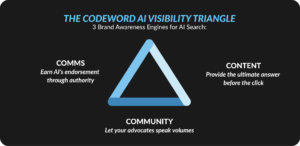
- Content: the primary source. Humans skim, but AI reads everything. Your content’s new job is to satisfy AI’s thirst for context, so it can satisfy humans’ thirst for answers.
- Comms: the credibility signal. PR is the new backlink. Large Language Models (LLMs) and generative AI determine truth and authority by consensus and source quality.
- Community: the audience validation. AI learns your brand’s true value not from your claims alone, but from real users validating your use cases in public forums. If people aren’t mentioning your brand, AI won’t be either.
The non-negotiable investments for brand marketers in 2026
Even if leadership knows how important AI visibility is, many are still unsure who needs to own it or how to achieve it. Is it a comms problem to solve? A marketing problem? Maybe a brand problem? The simple answer is: all of the above. AI Visibility isn’t currently a line item on anyone’s budget, but in 2026 it should be on everyone’s.
To win in this new area, brands need to go back to the basics. All the signals that result in strong visibility in AI search are rooted in brand-building foundations like quality owned content, strong earned presence, and a clear brand narrative. But these basic principles have been slowly eroding over time as marketers chase quick wins, vanity metrics, and incremental achievements that prioritized professional visibility over brand success.
Going back to brand-building foundations is all that’s needed to win on a new channel that’s looking for tried-and-true brand signals. All these items likely already exist on the budget, they just need a bigger investment in 2026 to result in business impact.
The 4 essential investments all brands need to prioritize in 2026
- Corporate blogs and content hubs: Detailed websites function as primary source material for AI consumption. While traffic may be low, AI is reading and serving the content brands are creating to relevant, interested audiences. One telecommunications company increased AI Overview inclusions by 253% by simply focusing on AI-native content structuring and semantic clarity. In 2026, invest in content strategy, corporate blogs and content hubs, expand FAQs and About Us pages, and create branded digital publications if you want to impact your brand presence across AI search results.
- Strategic comms and PR: Digital PR is essential for your brand’s AI visibility. A recent study by Muck Rack showed that more than 89% of links cited by AI are earned media, meaning if your brand isn’t showing up in news, it’s not showing up in AI. Investing in PR that consistently supports brand narratives and direction provides third-party consensus and signals credibility to AI. In 2026, invest in strategic, proactive, and targeted PR efforts, develop clear brand narratives and executive swimlanes, build website news hubs and media kits, and prioritize thought leadership and executive comms.
- Community channels and strategy: More than any other source, AI finds social proof and confirmation from user-generated content sites like Reddit, Quora, and YouTube. A June 2025 study found that Reddit was the most frequently cited web domain by large language models (LLMs) with approximately 40% of all citations by AI results. Proactive community engagement, management, and content creation builds authentic validation and digital word of mouth. In 2026, invest in setting up community building and management on channels like Reddit and Quora, create informative, long-form YouTube videos that detail how your products and services work, and invest in influencer strategies and community campaigns that engage and expand reach to relevant audiences across the web.
- Always-on measurement and analytics: AI capabilities, how people use AI, and measurement tools are evolving daily. Ensuring you have a team who can keep an eye on changes, competitors, and develop and measure AI metrics is essential for keeping on top—and winning—in this new era of AI marketing. In 2026, invest in always-on AI Visibility monitoring, community and social listening, brand sentiment and narrative analysis, and tracking and developing metrics that measure and communicate brand impact across AI models.
Where to cut to fund AI brand growth
Luckily for your budget (and its likelihood of approval) funding AI Visibility doesn’t require pure addition, it just needs some budget reallocation. To fund the effective, impactful AI Visibility tactics, you have to cut the funding of outdated, obsolete tactics that no longer serve brand marketers.
Three budget cuts marketers need to make in 2026
- Generic, volume-driven SEO: Stop funding content created purely for ranking. Yes, many SEO practices still apply to GEO, but they serve different objectives. Cut the budget for low-value, site-wide schema updates or manually rewriting old meta descriptions. Reallocate this budget to entity resolution and structural markup (e.g., HowTo, FAQPage) that directly informs LLMs.
- Overinvestment in underperforming paid media: You can buy attention, but you can’t buy authority. Plus, if you’re using AI as a tool for paid optimization, personalization, and creative iteration, you’ll be generating cost efficiencies that can be reinvested into building authoritative AI infrastructure for your brand.
- Performance-only strategy: Combining brand strategy with performance strategy boosts total revenue by 90% when compared to performance-only strategies. Relying too heavily on quick wins and vanity performance metrics means you’re ignoring your brand equity and the long-term gains that come with it.
Proving the ROI of AI Visibility
Any investment needs to come with a clear return, and leadership teams are going to need a crisp argument for this budget shift. The strategic justification for AI Visibility comes from metrics that move the needle in 2026. But if we aren’t tracking clicks and web traffic in a zero-click marketing landscape, what are we tracking? We need new, defensible benchmarks for brand authority and impact in the era of AI visibility.
4 metrics to measure for AI visibility
- Share of Model: Share of Voice is one signal, but it’s not the only one that measures your brand’s influence. Share of Model (SoM) measures how often your brand is represented in AI models, relative to your competitors. By tracking relevant prompts, you’re able to measure and strategically plan around how and where your brand and competitors are showing up across AI.
- Competitive Positioning: Similar to traditional search rankings, understanding where your brand is positioned relative to competitors is a strong indicator of brand relevance, influence, and authority. Even with a higher Share of Model, the goal is to be mentioned ahead of competitors in situations when AI is recommending multiple options to users.
- AI Sentiment and Bias: Measuring the tone and context of AI brand mentions is critical. Is the LLM output neutral, positive, or negative when discussing your brand? What sources and citations are driving this response? Understanding how your brand is showing up provides the direction needed to improve and influence over time, and can be an essential crisis management indicator for proactive decision-making.
- Narrative Alignment: This tracks how closely the AI-generated narrative aligns with your official brand messaging and communications strategy. High alignment proves your investment in across content, comms, and community sources is feeding the model your brand truth.
| A large tech company we work with has already been able to measure their AI visibility including sentiment, narrative-alignment, and share of mentions compared to other top data center companies in the space. This information has informed decisions around content strategy, message development, channel planning, and community management. |
AI Visibility is brand visibility
The data you’ll be tracking to measure your brand’s AI visibility and prove ROI aren’t just helpful for reporting, they provides a stream of business intelligence for future planning and opportunities. The biggest advantage of AI Visibility tracking is the deep understanding of sources and citations that are driving visibility for your brand and competitors.
Understanding where your brand needs to show up to show up on AI is essential for planning, prioritization, and driving more business impact. This intelligence can inform PR strategies (which publications should I prioritize? Which specific journalists should I target?), channel prioritization (which social channels are fueling the conversation, who are the advocates I need to be paying attention to?), and your content investment (what information isn’t showing up? What topics need more primary source detail?).
Investing in AI Visibility is more than just an investment in your brand’s presence online, it’s an investment in your entire brand strategy.
Frequently Asked Questions (FAQs) about AI Visibility and GEO
AI visibility is new, it’s scary, and it’s here to stay. Here are some answers to some frequently asked questions to help you make informed decisions for your 2026 budget and beyond.
What is AI Visibility?
AI Visibility (AIV) is the practice of increasing and improving a brand’s digital footprint (content, communications, and community) to ensure its narrative is accurately, consistently, and authoritatively cited across AI tools like ChatGPT, Gemini, and CoPilot.
How is GEO different from SEO?
Traditional SEO focuses on optimizing for search engine algorithms to improve ranking on search results pages and drive clicks to websites. AI Visibility focuses on optimizing for the generative models to ensure your brand is cited as the primary source within the AI’s direct answer, as audiences move away from clicking on websites and toward finding answers through AI.
What is Google Zero and what does it mean for my brand?
Zero-Click Landscape, often termed “Google Zero”, describes the rise of generative models (like Google’s AI Overviews and AI Mode) that synthesize and answer a majority of user queries directly on the SERP without requiring a click-through. This shift means brands need to rethink how they show up online, and how they measure success as web traffic and clicks reduce.
How do you measure brand AI Visibility?
Measuring success needs to move beyond simple web traffic and performance metrics. Key metrics to measure for AI visibility include Share of Model (SoM, how often your brand is showing up relative to competitors), Competitive Positioning (where your brand is showing up relative to competitors), AI sentiment and bias (how your brand is showing up on AI) and Narrative Alignment (how accurately your brand is showing up on AI).
How is Share of Model (SoM) calculated?
Share of Model (SoM) is the competitive benchmark that tracks how often your brand is cited by generative AI models, relative to your competitors, for a statistically sampled set of target queries. It’s measured using specialized tools that analyze AI citation frequency and prominence across LLM outputs.
Why is my PR budget now considered a GEO investment?
PR is a core AI Visibility lever because earned media acts as an essential backlink signal. Generative AI determines source quality by weighing E-E-A-T signals and authoritative third-party validation. High-quality media mentions provide the essential credibility signal that compels AI to endorse your narrative.
What kind of content should I be investing in for AI Visibility?
You should invest in entity-rich content, organized into modular, self-contained narratives and data points that function as authoritative primary sources. Prioritize exhaustive, niche content hubs that cover entire topical domains, structured for extractability using formats like semantic triples, organized lists, and tables.
Why is Community (like Reddit) important for AI Visibility?
Community is essential because LLMs and generative systems prioritize User-Generated Content (UGC) from channels like Reddit and Quora for queries involving troubleshooting, product comparisons, and real-world usage tips. Budgeting for proactive engagement ensures your advocates provide the authentic narratives and utility signals that AI systems use to validate a brand’s value.
What is ‘Semantic Chunking’ and why is it mandatory for AI Visibility?
Semantic Chunking is the practice of breaking down long-form content into short, clear, and logically discrete sections that express a single complete idea. It is mandatory for GEO because LLMs retrieve and synthesize information at the passage level, not the page level. Cleanly chunked text dramatically increases a passage’s extractability and likelihood of being chosen by the AI.